
The Stoic Strategist
You Start Losing Control Before the Decision Feels Urgent
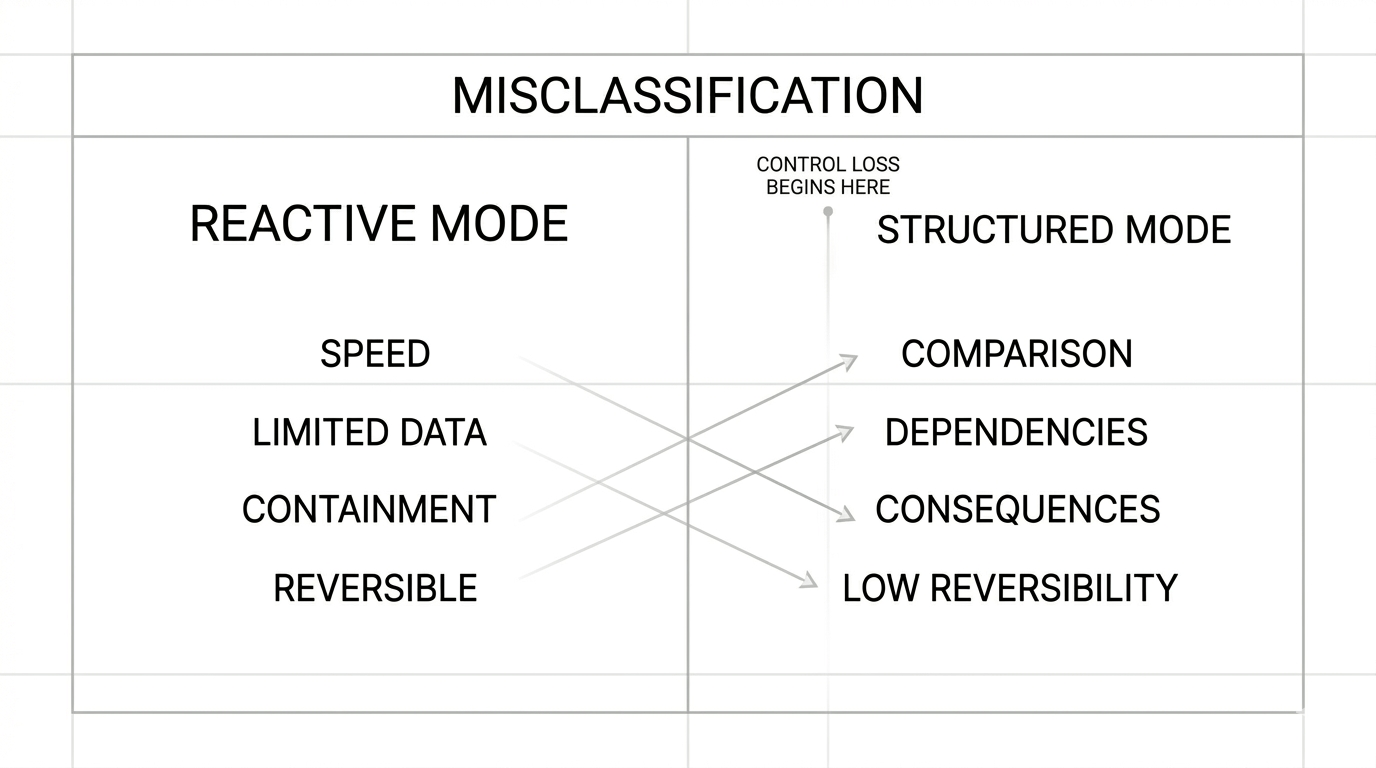
Decision quality under pressure deteriorates through a recognizable pattern: classification fails before action fails, attention narrows before options disappear, and urgency spreads faster than evidence. The structural failure mode in this case is mislabeling the decision type, collapsing time horizons, and allowing physiological stress to dictate process.
Reactive Decisions vs Structured Decisions
The visible mistake is rarely the first mistake. Control usually fails at the point where a decision-maker stops distinguishing between urgency and importance, then shifts into reaction before the situation has earned that response. By the time the final call is made, the process has already narrowed. Attention has compressed, alternatives have disappeared, and the mind has started treating speed as proof of competence.
That pattern matters because reactive decisions and structured decisions are not simply fast and slow versions of the same act. They are different operating modes. A reactive decision is built for immediate movement under constrained time, limited data, and direct consequence. A structured decision is built for comparison, sequencing, and second-order effects. When leaders use the reactive mode in a situation that requires structure, they do not gain speed. They borrow speed and repay it through rework, correction, and avoidable exposure.
The early failure point is perceptual. Pressure changes what gets noticed, what gets ignored, and what gets treated as decisive. Signals that confirm the first interpretation rise in importance. Contradictory evidence is delayed or dismissed. The result is not dramatic loss of control. It is subtle compression of judgment. That is the stage where the control failure baseline becomes operationally important, because the breakdown begins before behavior looks unstable.
Two decisions can face similar constraints and still differ completely in process quality. In one case, incomplete information is treated as a reason to define a narrow objective, identify what is reversible, and set a review point. In another, the same incomplete information is treated as justification for broad commitment without categorization, invalidation criteria, or scope control. Both decisions may move quickly. Only one preserves optionality.
The practical distinction begins with mode selection. If the environment demands immediate containment, reaction may be correct. If the environment allows comparison, reaction becomes a liability. The first task is not to decide the answer. The first task is to decide what kind of decision this is.
This distinction is often missed because pressure disguises itself as clarity. The louder the environment becomes, the more tempting it is to assume that the path with the least friction is the right one. But low-friction movement is not the same as high-quality judgment. A team can align rapidly around a weak interpretation simply because no one has paused long enough to test the frame. In that sense, reactive mode is not dangerous because it is fast. It is dangerous because it can make untested assumptions feel settled.
Structured mode, by contrast, is not valuable because it is slower. It is valuable because it creates separation between observation, interpretation, and commitment. That separation is what allows a decision-maker to ask whether the issue is tactical or strategic, reversible or sticky, isolated or systemic. Without that separation, every problem starts to look like an immediate threat and every response starts to look like a necessary act of decisiveness.
A useful diagnostic is to ask what would make the current interpretation wrong. If no one can answer that question, the process is already too compressed. Another diagnostic is to ask whether the decision is being made to improve the situation or merely to end uncertainty. Those are not the same objective. Under pressure, the desire to end uncertainty often masquerades as operational discipline.
The core point is simple: reactive decisions are for containment, structured decisions are for architecture. Confusing the two creates the illusion of control while reducing actual control.
Tradeoffs in Speed, Accuracy, and Rework
Pressure creates a false tradeoff. Many decision-makers assume that structure reduces speed and that speed necessarily reduces quality. In reality, the wrong mode creates the worst combination of both. A reactive approach applied to a strategic problem often produces a fast initial answer followed by slow correction. A structured approach applied to a truly immediate threat creates delay where decisive movement was required. The issue is not whether to move fast. The issue is whether the decision mode matches the decision type.
Reactive decisions have one clear advantage. They reduce latency. In environments where delay carries direct cost, that matters. A security breach, a safety incident, or a rapidly deteriorating negotiation may require immediate containment before full analysis is possible. In those cases, the decision standard is not completeness. It is stabilization. The error comes when leaders extend that same standard into problems that involve dependencies, stakeholder effects, or long-tail consequences.
Structured decisions carry a different advantage. They improve discrimination. They force comparison between options, assumptions, and likely outcomes. That process takes more time at the front end, but it often reduces total decision time by preventing reversal. Rework is the hidden tax on poor judgment. Teams rarely describe it as a decision failure. They call it clarification, alignment, follow-up, or course correction. The label changes. The cost does not.
A fast answer that must be rebuilt is slower than a disciplined answer delivered once. That is why executive decision quality cannot be measured at the moment of commitment alone. It must be measured across the full cycle from interpretation to execution to correction. The decision that feels efficient in the room may be the one that creates the most downstream friction.
Under pressure, the mind overvalues immediate closure. Closure feels like control because it ends uncertainty. It does not necessarily improve the situation. This is where a compact response protocol becomes useful as an operational check rather than a slogan. Label the decision type before acting. Breathe to interrupt the physiological acceleration that narrows perception. Control the next action, the time horizon, and the variables that matter. Choose only after the mode is set. The sequence is brief, but it prevents the common error of solving the wrong problem at the wrong speed.
The tradeoff between speed and accuracy is also distorted by measurement. Many organizations reward visible responsiveness more than invisible prevention. A quick answer in a meeting is easy to notice. The avoided cost of a better-framed decision is harder to see. As a result, teams can become culturally biased toward immediacy even when immediacy creates more work. They optimize for the appearance of command rather than the durability of outcomes.
This is why rework deserves more attention as a diagnostic metric. Rework is not just an execution issue. It is often evidence that the original decision process was mismatched to the problem. If a team repeatedly revisits the same issue, redefines the same objective, or reverses the same type of commitment, the problem may not be effort. The problem may be mode selection. They are using reactive logic where structured logic is required, or structured logic where containment would have been enough.
Another useful distinction is between decision speed and decision cycle time. Decision speed refers to how quickly a commitment is made. Decision cycle time refers to how long it takes to reach a stable, workable outcome. Under pressure, people often optimize for the first and ignore the second. But organizations pay for the second. A decision that is made in five minutes and corrected for three weeks is not a fast decision in any meaningful operational sense.
The best leaders understand that speed is not a single variable. There is speed of recognition, speed of classification, speed of containment, and speed of strategic commitment. These should not all be maximized equally. Recognition and classification should become faster with training. Containment should be fast when harm is escalating. Strategic commitment should be fast only after the frame is sound. Treating all four as the same kind of speed is one of the most common causes of avoidable error.
When to Use Each Decision Mode
Decision quality improves when mode selection becomes explicit. Most leaders do not fail because they lack intelligence. They fail because they rely on a preferred tempo. Some default to speed in every situation. Others default to analysis in every situation. Habit then replaces judgment. Under pressure, habit feels efficient because it removes the burden of choosing how to choose.
Reactive mode is appropriate when four conditions are present. Time is genuinely compressed. The decision is at least partly reversible. The objective is containment rather than optimization. The available information is unlikely to improve enough, fast enough, to justify delay. In those conditions, the correct move is to define the immediate objective, act within a narrow boundary, and set a review trigger. The decision is not final in the strategic sense. It is a controlled intervention.
Structured mode is appropriate when the decision has broad consequences, low reversibility, or multiple dependencies. Hiring a senior operator, changing pricing architecture, entering a new market, or restructuring reporting lines should not be handled in reactive mode simply because the environment feels tense. These decisions require comparison, sequencing, and explicit tradeoffs. They demand a wider aperture than pressure naturally allows.
The practical problem is that many environments are mixed. An organization may face a real-time operational issue while also needing to protect a longer strategic decision. The immediate issue pulls attention toward reaction, and the strategic issue gets processed with the same compressed logic. The result is a decision that is fast in form but weak in architecture.
The correction is to separate layers. Label which part of the situation requires immediate action and which part requires structured review. Breathe long enough to stop urgency from spreading across the whole field. Control the scope by assigning one decision to containment and another to analysis. Choose the mode for each layer independently. This is not abstract discipline. It is a way to prevent one urgent variable from contaminating every other judgment.
Training matters because mode selection degrades under repetition of the wrong habits. Teams that reward instant answers will produce more reactive decisions, even when structure is needed. Teams that overprotect consensus will delay action, even when speed is required. The answer is not a slogan about balance. It is repeated practice in identifying decision type, boundary, and review point. That is why the training sequence matters more than general advice. Under stress, people do not rise to intention. They default to conditioning.
A practical way to choose mode is to test the decision against three questions. First, what is the cost of waiting. Second, what is the cost of being wrong. Third, how reversible is the next move. If the cost of waiting is high, the cost of being wrong is bounded, and the move is reversible, reactive mode is usually justified. If the cost of being wrong is high, the move is sticky, and waiting improves the frame, structured mode is usually superior.
Another useful test is to identify whether the decision is about stopping deterioration or creating advantage. Stopping deterioration often favors reactive containment. Creating advantage usually requires structured comparison. The confusion begins when a team treats every uncomfortable signal as deterioration. That mindset pushes them into defensive speed even when the real task is strategic design.
Mode selection also improves when authority is clarified in advance. If no one knows who can contain, who can escalate, and who can commit strategically, pressure will force those roles together. That creates bottlenecks at best and impulsive overreach at worst. Clear authority boundaries do not slow decisions down. They reduce ambiguity about which mode should be used and by whom.
Finally, teams should distinguish between confidence and readiness. Confidence is a feeling. Readiness is a process condition. A group can feel highly confident because everyone shares the same assumption. That does not mean the assumption has been tested. Readiness exists when the decision has been classified correctly, the scope is defined, the reversibility is understood, and the review trigger is explicit. Those are stronger indicators than confidence alone.
Decision Architecture for Mixed Conditions
Mixed conditions are where experienced leaders separate themselves from merely busy ones. Most real operating environments contain both immediate threats and slower strategic choices. A supply disruption may require same-day containment while also forcing a longer review of vendor concentration. A personnel conflict may require immediate behavioral limits while also exposing a deeper structural weakness in reporting design. If both layers are handled in the same mode, one of them will be mishandled.
Decision architecture solves that problem by assigning different standards to different layers of the same event. The first layer is immediate control: what must be stabilized now. The second layer is bounded assessment: what must be clarified before broader commitment. The third layer is strategic choice: what should change in policy, structure, or resource allocation after the immediate pressure has been contained. This architecture prevents the common mistake of turning every signal into a strategic referendum or every strategic issue into a rushed tactical fix.
Operationally, this means defining decision lanes. One lane handles immediate action with narrow authority, clear stop conditions, and short review intervals. Another lane handles structured evaluation with explicit assumptions, alternatives, and consequence mapping. The lanes can run in parallel, but they cannot be merged carelessly. When they are merged, tactical urgency hijacks strategic judgment.
This is also where many leaders discover the limit of insight alone. Understanding the mechanism of breakdown is necessary, but it does not create reliable execution. Reliable execution requires a repeatable structure for classification, escalation, and review. That is the point where a broader system becomes useful, especially in organizations where pressure is constant rather than occasional. For teams that need the full framework, the value is not complexity. The value is disciplined separation between what must be done now and what must be decided well.
The final outcome is practical. The reader should be able to choose decision mode by context rather than habit. That means recognizing when speed is the objective, when accuracy is the objective, and when the real requirement is sequencing both without contamination. It also means accepting that not every fast decision is reactive and not every structured decision is slow. Good operators move between modes deliberately.
A sound architecture also depends on review design. Every reactive decision should carry a trigger for reassessment. Every structured decision should carry a threshold for commitment. Without review triggers, reactive decisions harden into strategy by inertia. Without commitment thresholds, structured decisions drift into analysis without consequence. Architecture is not just about separating lanes. It is about defining how movement occurs between them.
This matters because mixed conditions often create emotional spillover. A team that has just handled a high-intensity issue may continue thinking in compressed, defensive terms even after the immediate threat has passed. That residual pressure can distort the next decision if no reset occurs. A brief reset is not ceremonial. It is a control mechanism. It marks the transition from containment logic to evaluation logic.
Organizations can strengthen this architecture by standardizing a few questions at each layer. For immediate control: what must stop now, who owns it, and when is the next review. For bounded assessment: what assumptions are driving the current interpretation, what evidence would change it, and what options remain open. For strategic choice: what long-term consequence matters most, what tradeoff is being accepted, and what metric will show whether the decision is working. Standard questions reduce the chance that pressure will erase process.
The broader lesson is that control is not preserved by intensity. It is preserved by design. Pressure will always compress perception, reward premature closure, and tempt people to confuse movement with progress. Decision architecture exists to counter those tendencies. It creates enough structure to keep judgment intact without making action impossible.
A leader who can identify the decision type, apply the right mode, and protect strategic judgment during tactical pressure will outperform a leader who simply moves fast or thinks hard. The difference is not temperament. It is structure applied at the right moment. When that structure is absent, pressure chooses for you. When it is present, you choose by context rather than habit.
Explore the full decision system: The Stoic Strategist Decision Framework