
The Stoic Strategist
Why Fast Decisions Feel Correct but Are Often Wrong
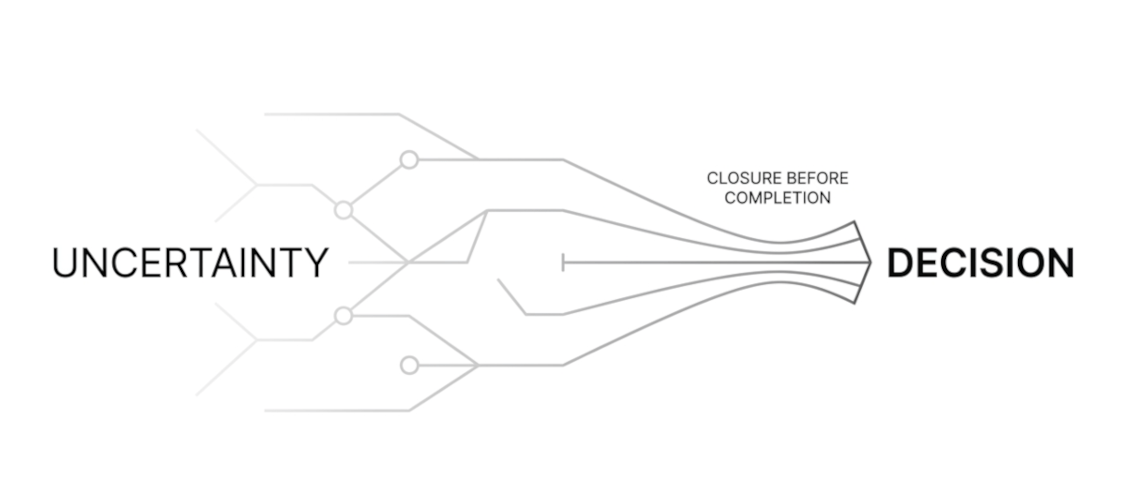
Fast Decisions Reduce Tension, Not Error
Fast decisions feel correct because they reduce discomfort, not because they improve accuracy. Under pressure, uncertainty becomes the primary source of stress, and the mind moves to eliminate that uncertainty as quickly as possible. A decision, even a poor one, provides immediate relief.
That relief is misinterpreted as correctness.
The faster the decision, the faster the tension disappears, which creates a direct psychological association between speed and confidence. The individual experiences clarity, but that clarity is artificial because it results from closing the decision process early rather than completing it accurately.
This is the failure point. Most people assume the problem is flawed reasoning or lack of information, but the problem occurs earlier, at the moment where the need for relief overrides the need for accuracy. In high-pressure environments, this distinction determines whether a decision holds under real conditions or collapses immediately after execution.
How Pressure Alters Decision-Making
Pressure does not simply make decisions more difficult. It changes the structure of the decision process itself. Perception narrows first, as attention shifts toward the most immediate and emotionally charged signals while relevant context falls away. By the time this narrowing becomes obvious, the mind is already moving through the early stages of how control breaks under pressure.
Judgment accelerates next, with the mind forming conclusions before observation is complete. The separation between what is seen and what is inferred disappears, and interpretation replaces observation without being recognized as such. By this point, the decision is already being shaped by incomplete information.
Reaction then begins to form before deliberate thought is fully established. The individual experiences the response as a decision, but the outcome has already been constrained by earlier stages in the process.
Why Fast Decisions Feel Right
A fast decision produces immediate psychological effects that are often mistaken for evidence of quality. Uncertainty is reduced, cognitive load decreases, and emotional tension drops. These changes create a sense of clarity and confidence that feels indistinguishable from correctness.
This is where most individuals make a critical error. They treat the internal experience of certainty as validation of the decision itself, when in reality the certainty is a byproduct of closure.
Under pressure, the brain is not attempting to produce the most accurate outcome. It is attempting to stabilize the situation as quickly as possible. Closure becomes the priority. The faster closure is achieved, the more stable the internal state becomes, reinforcing the belief that speed was correct while driving the same pattern of judgment failures that emerge under pressure.
The Sequence of Decision Failure
Failure under pressure follows a repeatable pattern. It is not random, and it is not dependent on intelligence. The process begins with a failure to detect escalation early, which means the individual is already behind the situation before they attempt to respond.
Attention then narrows, limiting the range of information being processed. Critical context is excluded without awareness, which leads directly into the next stage where interpretation replaces observation and assumptions begin to drive perception.
Urgency then dominates the process. The perceived need to act quickly overrides the need to act accurately. At this point, reaction is already forming, and by the time the individual consciously engages in decision-making, the outcome is heavily constrained.
This sequence can unfold in seconds, which is why understanding it conceptually is insufficient without a method that operates at the same speed.
The Critical Interval Where Control Is Lost
Most individuals believe that loss of control is caused by the intensity of the situation. They attribute failure to external pressure.
Control is lost because the individual fails to act within a specific interval. There is a brief period between recognizing a signal and reacting to it, and within that interval intervention is possible. If no intervention occurs, the process continues automatically and reaction takes over.
This interval is often missed because it is short and easily obscured by the speed of escalation. Without training, the individual does not recognize it in time. Recognizing that the interval exists does not change the outcome. What matters is whether a trained response sequence for pressure moments begins before reaction takes control.
The Response Sequence That Restores Control
Control is restored through a repeatable sequence that is applied during escalation rather than after it. The sequence is Label, Breathe, Control, and Choose.
Label stabilizes perception by forcing a clear, factual description of what is occurring, which prevents interpretation from compounding.
Breathe reduces the physiological response and creates measurable separation from immediate reaction, slowing the escalation process.
Control directs attention toward what can be influenced immediately while disregarding external variables, which restores functional focus.
Choose establishes deliberate action so the response is selected rather than triggered.
This sequence does not remove pressure. It changes how the individual operates within it by inserting structure into the decision process at the exact point where it would otherwise collapse.
Why Execution Fails Without Training
The sequence is simple to understand and difficult to execute. Under pressure, escalation accelerates rapidly, and without repetition the sequence is applied too late. By the time the individual attempts to intervene, reaction has already formed.
Without structure, steps are skipped. The individual moves directly from perception to action, which results in partial execution and inconsistent outcomes. Without training, the sequence does not activate automatically, and the time required to recall it exceeds the available window for effective intervention.
Most failures occur because the sequence is applied after the critical interval has passed. At that point, control cannot be restored through simple correction.
What Reliable Decision-Making Requires
Reliable decision-making under pressure is not a function of intelligence, experience, or intention. It is a function of trained response. The sequence must be installed through repetition until it becomes the default response to escalation.
This ensures that it is applied early enough to interrupt the process rather than attempting to correct it after the fact. Without this installation, the same pattern repeats consistently, which is why repeated execution drills for pressure decisions matter more than understanding the idea in the abstract.
Control Assessment
Most individuals overestimate their ability to maintain control under pressure because their assessment is based on memory rather than measured performance.
A useful evaluation requires examining recent events. How quickly was escalation detected? Was it recognized early, or only after the situation intensified? How long did it take to regain control? Was judgment altered during the event?
If these answers are unclear, control is weaker than assumed. Under pressure, perceived capability and actual performance often diverge.
Fast decisions feel correct because they resolve tension quickly. They do not improve judgment.
The difference between reaction and decision is measured in seconds, and that interval determines whether control is maintained or lost. Without a trained method to operate within that interval, even capable individuals default to speed over accuracy.
The result is consistent. Decisions feel right in the moment and fail under execution.
Explore the full decision system: The Stoic Strategist Decision Framework